
White Paper · ICAO + OFIQ
ICAO Face Photo Standards and OFIQ Quality Checks.
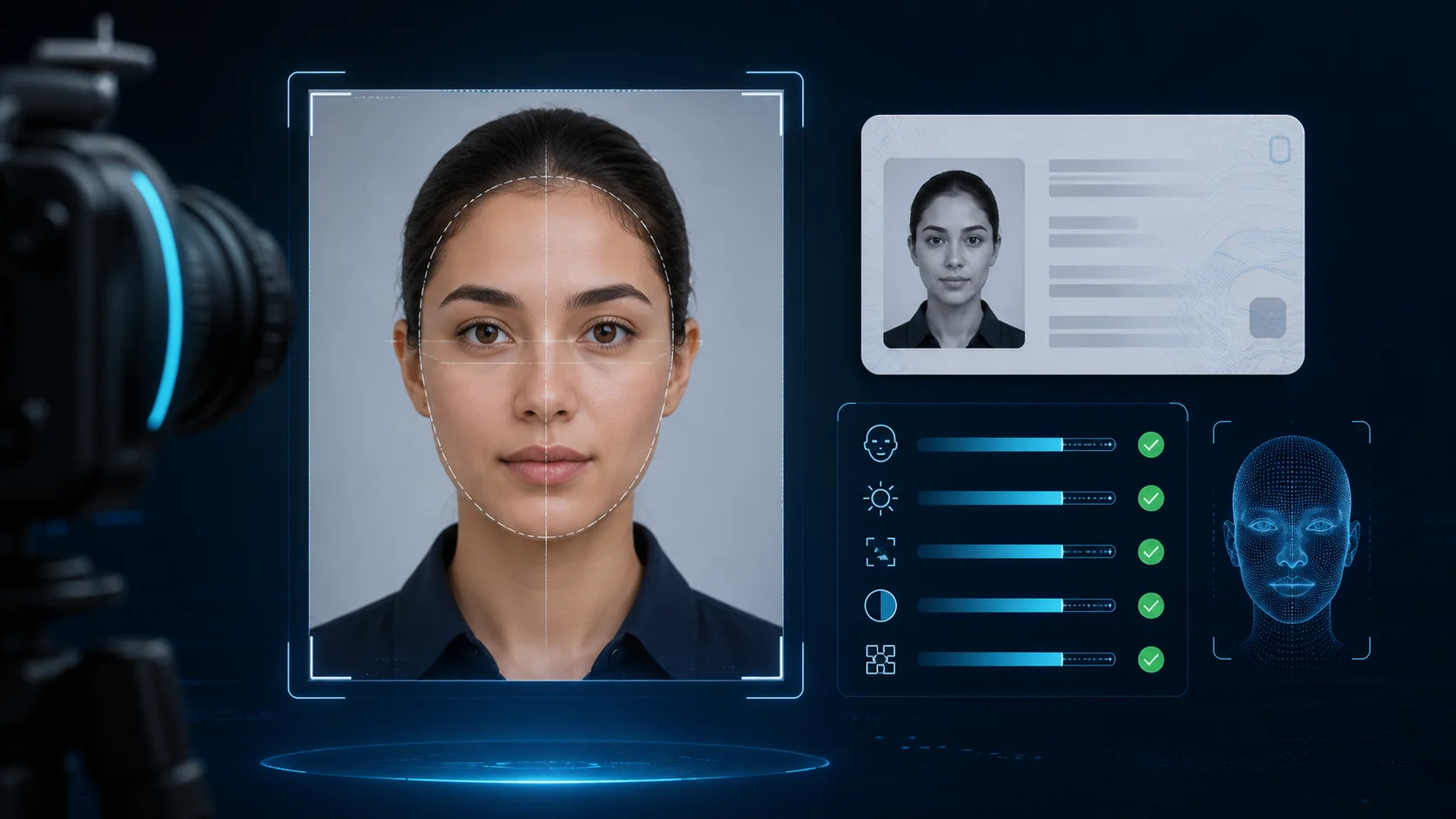
A face image on a national ID card is not just a photograph. It becomes printed evidence, machine-readable biometric data and the reference image used in future checks. ICAO portrait guidance and OFIQ quality scoring help programmes decide whether that face image is good enough before it becomes part of the identity record.
ICAO gives identity programmes a shared portrait language
ICAO is the International Civil Aviation Organization. In identity documents, its practical role is the Doc 9303 family of specifications for machine readable travel documents: passports, visas and official travel documents/cards that need to work across borders, inspection systems and issuing authorities.
Doc 9303 defines common document zones, machine readable zones, visual data conventions, eMRTD relationships and the displayed identification features of the holder. For the face portrait, the point is simple: the image must support both human inspection and automated facial recognition, without digital alteration that changes the person’s appearance.
A national ID card is not always a travel document, but many national ID programmes still adopt ICAO-style portrait rules because they make the face image predictable. The same capture discipline supports issuance, card personalisation, chip storage, border or agency verification, and later biometric matching.
Why the face on a national ID card needs stricter control
The portrait is the biometric that everyone can see, but it is also machine evidence. It may be printed on the card, stored digitally, matched against a live capture, used to detect duplicates or trusted as the reference image when a citizen returns for a service years later.
Small capture defects compound over time. A slight head turn, heavy shadow, reflective glasses, blurred focus, open-mouth expression, cropped chin, busy background or over-processed image can still look acceptable to a person at a counter. The same image can perform poorly when a camera, kiosk, border gate or mobile verification workflow tries to compare it.
That is why face-photo quality belongs inside the enrolment workflow. The programme should know while the applicant is still present whether the portrait has the right pose, visibility, illumination, crop, background and natural likeness. Recapturing at the desk is cheap; discovering the problem after card production, biometric deduplication or field verification is not.
OFIQ turns face quality from opinion into a measurable gate
OFIQ stands for Open Source Face Image Quality. It is the German BSI’s reference implementation for ISO/IEC 29794-5, the international face-image quality standard. Instead of asking an operator whether a photo “looks fine,” OFIQ measures properties of a single image and returns component scores plus a unified quality score.
Those components look at the things that matter to biometric usability: whether a face is detected, whether the head pose is suitable, whether illumination is even, whether the image is sharp enough, whether the background is controlled, whether the expression is neutral and whether occlusion or image artefacts are likely to harm matching.
OFIQ is not a face matcher and it is not liveness detection. It does not decide whether two faces are the same person, and it does not prove that a live person was present. Its job is earlier and very practical: decide whether this one face image is suitable enough to enter the identity record or whether the operator should recapture it.
What OFIQ is used for in a real programme
At enrolment, OFIQ can guide the operator before acceptance: move closer, remove glare, look straight at the camera, improve lighting or retake the image. That makes the quality rule actionable instead of turning it into a rejection message after the citizen has already left.
Before issuance, OFIQ can act as a policy gate. The programme can define which quality failures block card production, which create a supervisor review and which are only logged for analytics. That is especially useful in national ID deployments where one weak enrolment image may become the trusted face record for many services.
At operations level, OFIQ makes quality visible across devices, sites, agents and regions. If one location is producing low sharpness scores, if a specific camera setup creates illumination failures or if a field team has unusually high recapture rates, the issue becomes measurable and fixable rather than anecdotal.
The practical rule: score while the person is still there
The strongest quality policy is not the strictest threshold on paper. It is a workflow that detects a bad image early, explains the issue clearly and gives the operator a chance to recover. For national ID cards, that means face capture, quality scoring, liveness where required and review rules should sit together in one enrolment journey.
ICAO-style portrait discipline gives the programme a consistent target. OFIQ gives the programme a repeatable way to measure whether the captured image reached that target. Together, they protect the card, the biometric database and the future verification experience from avoidable capture mistakes.
Online OFIQ demo
Try a face image quality check online.
Upload two photos, see OFIQ-based quality outcomes and compare whether the faces match under the demo threshold.